
For authors, musicians, creators, and IP strategists in the U.S., the start of the year marks Public Domain Day. On January 1, 2026, a s̶h̶i̶t̶l̶o̶a̶d̶ respectable number of cultural works from 1930—alongside sound recordings from 1925—officially entered the U.S. public domain.
I often discuss intellectual property protection. But creativity isn’t confined to legal silos—it lives, grows and changes in the public domain by fueling new art, technology, business models, and remixes. This year’s additions offer culturally important material: noir detectives, golden-age animation, and baseline jazz recordings, all ready for what creators love doing — reinterpretation and revitalization (and not just by turning beloved characters into killers).
To fully appreciate these opportunities, it’s worth examining what entered the U.S. public domain at the outset of 2026. It is also well worth exercising legal caution, as the scope of these freedoms outside of the United States is not coterminous with U.S. law.
Actually, this is a great place for this caveat: This is not legal advice. If you rely on it without talking to your lawyer, you are likely to get in trouble. Copyright law, particularly in the international context, is very complex and I’m not even attempting to provide the kind of advice that you should rely on to keep you legally safe. While we’re at it, here is an AI Use Disclosure: In keeping with the site’s AI Use Disclosure Policy, I used AI to research this piece and to refine a lot of the prose. It’s still me behind it, but I had a digital helper. I also question the accuracy of AI detection software. It passes as human-written — except that I just told you parts of it aren’t.
Bear in mind that copyright law is highly territorial. I can’t violate a U.S. copyright by selling unlicensed copies in Canada, and I can’t violate a Canadian copyright by selling unlicensed copies in the U.S. The nature of the internet is such that there is a real risk of inadvertent infringement — for example, by putting a work in the U.S. public domain online and having it downloaded within a jurisdiction where it remains copyrighted.
The Class of 1930: What Enters the U.S. Public Domain?
Under U.S. law, works published in 1930 enjoyed a copyright term of 95 years from publication. Those copyrights expired at midnight on December 31, 2025, meaning that as of January 1, 2026, these works may be freely used, reproduced, and adapted within the United States without authorization or payment.
Literature: Detectives and Modernism
The Maltese Falcon by Dashiell Hammett
The novel that birthed the hard-boiled detective archetype. Sam Spade—the terse, cynical private eye—steps fully into the public domain. His character as depicted in the 1930 novel, along with the dialogue and plot, is now open to reinterpretation. The famous 1941 film adaptation, however, remains under copyright as a separately protected derivative work. For the film student looking to make a splash, there is nothing stopping you from making a movie based on the book (provided you only distribute it in the US).
The Murder at the Vicarage by Agatha Christie
Miss Marple debuts in this novel. U.S. creators may now use her character as she appeared in this 1930 work, though later character developments remain protected.
The Secret of the Old Clock by Carolyn Keene
Nancy Drew’s first story is now in the public domain. Later versions—particularly the revised editions from the 1950s—remain protected as separate copyrighted works.
As I Lay Dying by William Faulkner
Faulkner’s modernist classic is now open for adaptation, whether as stage plays, audio dramatizations, or contemporary reinterpretations.
Additional Highlights:
- Laughter by Henri Bergson (English translation, Knopf 1930) – a philosophical treatise on comedy.
- Collected Poems by W.B. Yeats (if published in the U.S. in 1930)—some editions may now be accessible, though careful attention to textual variants and publication history is essential.
Film & Animation: Pre-Code, Precedent, and Plenty of Personality
Betty Boop
She made her animated debut in Dizzy Dishes (1930), starring as a canine-flapper hybrid. These early cartoons are now open for reuse, though the modern, stylized Betty Boop image is still protected under both trademark law and subsequent copyrights.
Pluto (as “Rover”)
The unnamed dog character from Disney’s The Chain Gang (1930) is generally considered the first appearance of Pluto. His 1930 depiction is now in the public domain, though Disney retains trademark rights and copyrights in later, more developed characterizations.
All Quiet on the Western Front
The seminal anti-war film that won Best Picture. The film adaptation is now in the public domain in the U.S., along with the German-language novel it was based on (by Erich Maria Remarque) and its original 1929 English translation. However, more contemporary translations remain copyrighted. Don’t assume the version of the translation you are using is public domain — it may not be. At the same time, what an interesting case for AI: Have AI translate the original version of the book. That translation would not be copyrighted in the US (unless and until US copyright law is interpreted or modified to allow AI to hold or generate copyrighted material).
Animal Crackers
The Marx Brothers classic now enters the commons. Expect a boom in zany stage adaptations and homage pieces (or not; it is far from clear that what was “zany” in 1930 will appeal to the TikTok Generation).
Music: Sound Recordings from 1925
Thanks to the Music Modernization Act of 2018, U.S. sound recordings fixed before 1923 entered the public domain in 2022, with subsequent years following on a rolling basis. Sound recordings from 1925 entered the public domain on January 1, 2026.
Highlights include:
- “St. Louis Blues” by Bessie Smith and Louis Armstrong
- Duke Ellington’s early jazz recordings
- Ethel Waters, Fats Waller, and Ma Rainey performances
- Early big band and Delta blues recordings from Okeh, Paramount, and Victor labels
These recordings can now be sampled, remixed, embedded, or redistributed without securing a master use license, though the underlying musical compositions may remain separately protected.
Watch Your Borders: These Works Are Not Free Everywhere
Here’s where things get trickier for international use. U.S. copyright law applies a term of 95 years from publication for works published between 1928 and 1977, but most other jurisdictions follow a life-plus-70-years term. Canada recently extended its term from life-plus-50 to life-plus-70, though without retroactive application. These divergent frameworks mean that a work in the public domain in the U.S. may still be protected elsewhere, creating a complex patchwork of territorial rights and potential infringement exposure for anyone distributing content globally.
Case Study 1: Dashiell Hammett – The Maltese Falcon
- U.S.: ✅ Public Domain
- Canada: ✅ Public Domain (Hammett died in 1961; under Canada’s previous Life+50 term, his work entered the public domain in 2012)
- UK/EU: ❌ Still under copyright until the end of 2031 (1961 death + 70)
Strategic Note: While your Sam Spade graphic novel or video game is lawful to distribute in the U.S. and Canada, distributing or marketing it in Europe without authorization could constitute copyright infringement. These jurisdictional differences create meaningful legal risk for cross-border exploitation. This is particularly risky given that the internet is designed to make things available regardless of location. Before just putting it up on a website, you would want to engage some form of geofencing.
Case Study 2: Agatha Christie – The Murder at the Vicarage
- U.S.: ✅ Public Domain
- Canada: ❌ Copyrighted (Christie died in 1976; protected until the end of 2046)
- UK/EU: ❌ Same as Canada
Strategic Note: A uniquely American opportunity—one of the world’s most famous detectives is legally available only in the U.S. market. Outside the U.S., the work remains under copyright protection.
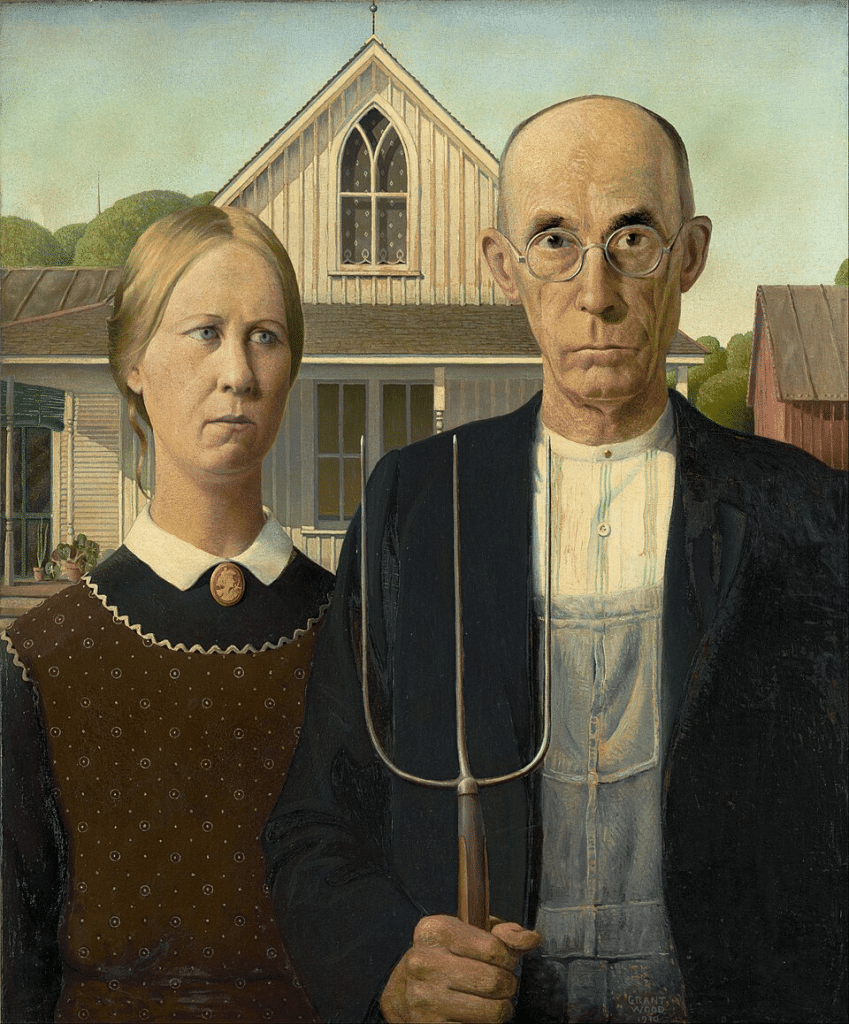
Case Study 3: Grant Wood – American Gothic
- U.S.: ✅ Public Domain
- UK/EU: ✅ Public Domain (Wood died in 1942)
Observation: The painting entered the public domain in Europe over a decade ago. It’s now freely available in the U.S. as well.
Oh, heck. Why not? Here it is, royalty-free:
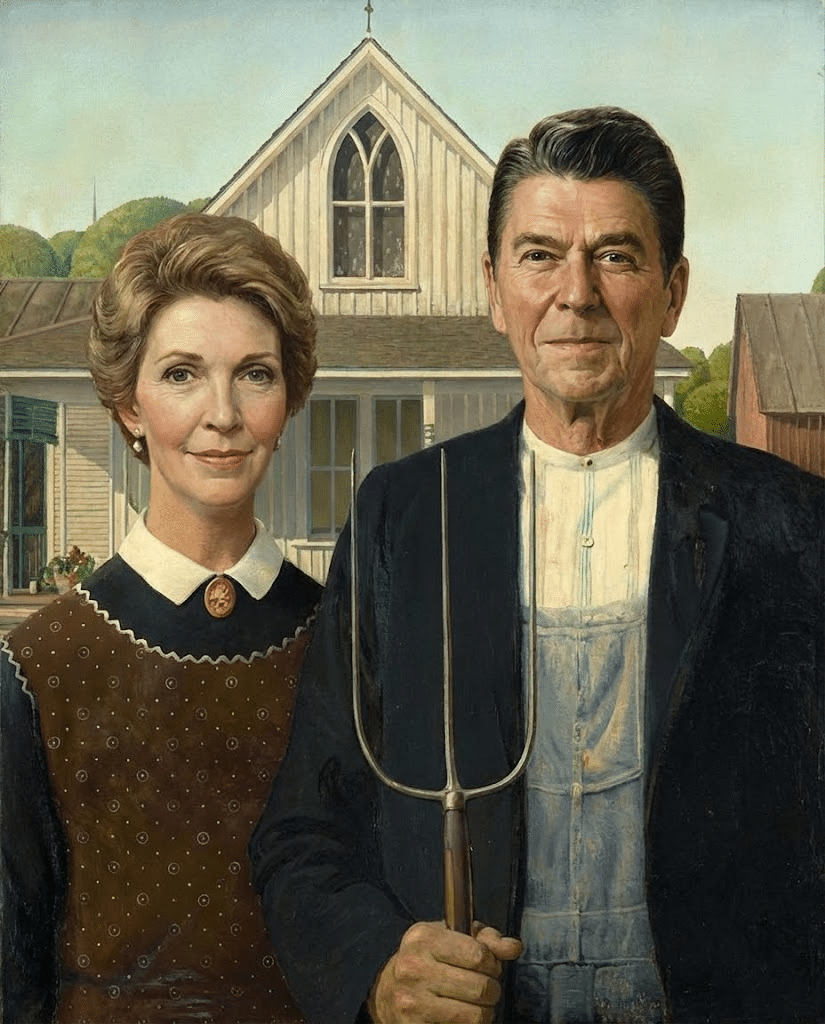
While we’re at it, here’s an unlicensed derivative work (done with AI, so there is no copyright to it; the original expired, and a human didn’t create this version):
IP Strategy: How to Use These Works Creatively and Legally
- Trademark rights still apply. The fact that early Betty Boop animations have entered the public domain doesn’t grant you the right to use the modern, stylized Boop image as a trademark or in commercial branding—those rights remain separately protected.
- Right of Publicity still applies. The right of publicity for a living person could, in theory, be violated, for example, if a photographer took a photo of Marty Methuselah in 1920 at age 2, and he is somehow still alive now, commercial use of that image could violate his right of publicity. Beware, though, that you could still violate a posthumous right to publicity if that exists in the jurisdiction in question.
- Base derivative works only on the original 1930 versions. Later revisions, editions, and adaptations remain under copyright as separate works.
- International distribution presents serious legal risk. Consider geofencing your content or consult qualified IP counsel before releasing works worldwide, as materials in the public domain in the United States may remain protected in other jurisdictions.
The Innovation Opportunity
Public Domain Day represents a major creative and commercial opportunity, but it’s not a free-for-all. Jurisdiction, specific editions, and overlapping trademark rights all matter. As they say in the UK, “watch the gap”. Public domain is essentially a collection of different rules in different countries, and gaps in falling into the public domain are rife. It is a sad reality making it all the harder to bring culturally important, century-old 20th-century works to new audiences.
Sam Spade can solve new mysteries on your podcast. Miss Marple can investigate cases in a webcomic. Bessie Smith’s voice can be sampled in your AI music engine.
Go forth and create—just make sure you’ve checked the copyright map first.